Showing posts with label creation. Show all posts

Wednesday, August 31, 2016

Stop feeding the monster: Bird lessons in life


This week a handyman finished repairing holes in the siding of our house. A woodpecker hammered away until there were three holes large enough for chickadees to nest in. This is not a joke. They actually did. If you timed it right you could see a parent returning with little green worms and if you listened closely you could hear the ecstatic cries of the babies when dinner arrived. It was an odd thing to see a chickadee perched on the hole’s edge, its head poking out the side of our house. Whether advisable or not, we waited until they moved out before the work was done.

We are a little obsessed with bird-watching around here and learn all kinds of life lessons from them. Not that I take to the woods with binoculars. No. I’m too fat and lazy for that. We have extremely popular feeders on our deck so all I need to do is sit at my desk sipping coffee and twist my neck to watch. I try not to get too distracted by the constant commotion outside my window, but the other day I was disgusted by something I’d never seen before – a tiny song sparrow feeding a baby bird about four times her size. The baby was fluttering its wings as young ones do while the exhausted parent flew back and forth to the feeder, grabbing seeds and popping them in the demanding open mouth. Back and forth, over and over. I was witnessing the perpetrator of a malicious crime. Slavery. A murderer of sorts. An imposter. Pig. And here was a mother who didn’t even know this was not her own child.
This was a purple finch (little larger species than song sparrows) nest we found on our porch some time ago, but you can see the cowbird egg which is larger and a mottled brown. I removed it returned the nest to the rightful owners. 
Male Cowbird
The baby was a young cow bird whose mother had spied the innocent song sparrow’s nest a month or more ago and stealthily laid her own fat egg among the tiny sparrow eggs. The cow bird can’t be bothered to hatch her own eggs and instead sneaks into another bird home and leaves a fake. And it isn’t like the hatchling joins the rest of the brood thankful to be fed, thankful to be anywhere at all – it always hatches first – ugly, (okay all baby birds are ugly, but I’m annoyed here) blind and featherless, and then it commits fratricide by pushing the other eggs out of the nest to destroy all competition. You may not approve of this, but my husband set the foster mother free by dispatching the imposter.

It’s one thing to hear David Attenborough talk about certain disturbing aspects of bird life, but altogether a different thing to witness it firsthand.

I love metaphor and this was so flagrant I had to reflect on it. I don’t know if you’ve ever found yourself far gone down a road you had no idea would end up severely depleting or even destroying your assets? Or health? Or family? I once nurtured a multi-level marketing company thinking it could make me, if not rich, then able to purchase “extras” like Calphalon cookware, percale sheets and massage therapy. I loved the product and invested a lot of money trying to make sales only to learn that as the months passed with little to show for my effort, it became clear I was the worst salesperson on earth. This was not becoming the nest egg I’d hoped for because I couldn’t bring myself to tell you how much good this skincare line could be for your flaky, pock-marked face. But I continued feeding time and money into the maw of the business hoping it would get better. Gradually, I fell into discouragement and guilt, but for several years I was afraid to quit. How could I admit such failure to my husband who had supported this risk? How could I make up the lost dollars? Finally, I told him how much I hated sales and how sorry I was for the wasted money and how afraid I was to stop feeding this monster in my life because I’m not a quitter, but what could I do? Then came one of the most wonderful proofs of grace in my life. He said – “Stop doing this. Let it go and don’t worry about it. It’s a valuable thing to try something out to see if it will work and to find out it doesn’t. You didn’t know this wouldn’t be your thing. So let it go.” I quit immediately and I’ve never forgotten the love he demonstrated in walking through that with me.

Epilogue: we’ve seen another batch of song sparrow babies that are genetic offspring. Definitely. I even imagine I’m hearing happier songs.


Thursday, April 9, 2015

Look at the moon!

Creation can shine on a chill and dreary day – which is the kind of day it is today. It always surprises me how effortlessly it tosses us bits of excessive wonder. I love imagining how ever in the world could God come up with so many things that radiate light into our lives. I’ve pondered Jupiter this month as it glows next to the moon in the month of April. I’ve said it so many times and why is it that you probably do too? We say, “Look at the moon!” as if we’ve never seen it before? Today I’ve watched chickadees arc to the feeder at a hundred miles per hour and land delicately as a ballerina on a teeny perch. Last night we flash grilled marinated beef on skewers – my version of sate and it tasted killer good. We wonder how two fallen, scratchy people, image bearers of God, can stay together long enough to be old fogies and even laugh about it. And why are bunnies so stinkin’ cute when they eat carrot peels? 
                           
And right now, this minute, if I stepped out and opened my mouth to the sky I’d probably choke to death because a rare spring snow is falling in beautiful enormous chunks. 
 In the words of David Clowney’s hymn, I believe:

God, all nature sings Thy glory, and Thy works proclaim Thy might;
Ordered vastness in the heavens, ordered course of day and night;
Beauty in the changing seasons, beauty in the storming sea;
All the changing moods of nature praise the changeless Trinity.

Even I, flawed as I am, proclaim his might and beauty. 

Friday, May 9, 2014

Ice Jam

It’s been more than a month since I’ve posted and I’m sorry about that. I'm going to try to ease back in here. I’ve been dammed up like the Zumbro river I mentioned in the last issue of Notes From Toad Hall. We captured a little video of the muddy waters and chunks of ice moving under the bridge. The gradual building of pressure finally broke an ice jam and we happened to be there at the moment it happened. Something I’d never seen before. It was both frightening and fascinating at the same time.


Ice jam on the Zumbro River
Everything has had to come together from prepping, selling, looking for and purchasing another house and it has, in amazing ways. But I am excruciatingly aware that people do this all the time, and some do it over and over again, and I am that anemic American that thinks moving is tough. During the first six years of our marriage we moved thirteen times; somehow I’ve either forgotten what it took or just don’t have the stamina anymore. Plus, it has been thirty-three years since we last moved; that's a lot of time to forget how to pack boxes. You’d think I’d be more mature about the unknowns and the stress, but no, it seems not.
It’s not just the upheaval of moving or entering a new stage of life, it’s a combination of other things that add to being somewhat depressed and emotionally jerked around. Like earlier this week I learned that my recent up-tic in hearing loss qualifies me for hearing aids and that this isn’t going to go away, like I hoped it would. And I may need to wait awhile before we can afford them. (So I might be saying WHAaaa? a lot.)  One moment I’m so thankful we sold Toad Hall in three days and the next I’m quite certain we will never find another house that works for us and we’ll end up living in a yurt in my mother’s back yard. This has made it hard to think or write in a fundamentally coherent way. On lots of days going to bed with Almond Joy bars and People magazine seems like a good option, but honestly, I only succumbed yesterday when I couldn’t resist George Clooney on the cover. But even more shameful, is being tempted to buy the nasty National Enquirer. Fortunately I said, Satan, get behind me, and really? I mean, really? People, I don’t think dressing in a kilt qualifies as cross-dressing.
Camilla's World Falls Apart
 I have a friend whose family has been with the State Department and they have relocated across the world many times. She says that each time they moved she wished she were a nun and only needed to pack an extra habit, prayer beads and a cot, but the feeling passed once they got to their new home. I count on that feeling to return. The good news is that we haven’t needed to down-size as much as we initially thought, and in the new house we get to look out the back to a wooded ravine and park full of birds, predators, wild ginger and ramps. A bedroom and laundry on the main floor, and a wonderful and convoluted journey through the wilderness of real estate negotiations brought us to this house. I didn’t think we would make it, but my husband did. In all, we have much to thank God for.
Thank you for stopping by and, again, I apologize for being so spotty with postings, but don’t know how much better I will do in the next few weeks as we continue to pack and plan to move at the end of the month.

Tuesday, January 14, 2014

Honeysuckle digs a rug

The arrival of very cold weather has us letting Honeysuckle into the house more often. Her wool has grown long and thick, so we don't worry much even when it is 20 below. She loves the cold far more than the hot. It makes her very lively and getting inside to cause a bit of mischief is a daily goal. When she hears the knob on the kitchen door, she hops down out of her hutch and tears across the porch planning to enter by force if necessary.
She has a taste for electric cords - and especially enjoys severing computer power cords. She also likes to scratch and push her way past the barriers that keep her from going behind the couch. She loves treats and comes like a white tornado when she hears the refrigerator opening - which definitely means something delicious like napa cabbage, carrot or apple.
After hopping around to inspect all her nooks, she often settles down for a nap, usually at Anita's feet or snuggled under her arm - as you see here.
Bunny Naps
A Christmas nap.

Sometimes we talk about pets, how they capture our hearts. How they make us laugh. How exasperating they can be, and how when they are sick or injured we must weigh… them, their worth. How much is too much to spend in making their lives better? What can we afford? Animals are grace to many of us. In creation, in the hoppiness of a bunny, the way she lifts her tufted ears, merely being her creaturely self, we see the goodness of the creator represented and are thankful for these small blessings.


I hope there are things in your life that bring you pleasure and the recognition of God's love for all his creatures, including you and me.

Wednesday, November 6, 2013

There are Chickadees


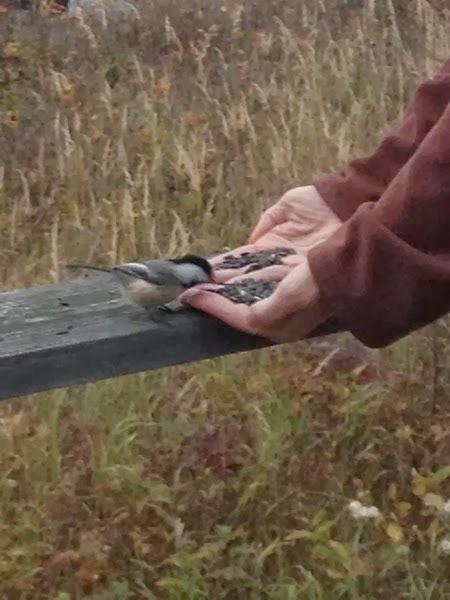
One thing I've always wished I could experience is to have a wild bird eat from my hand. I've always loved chickadees - they are so small and cheerful. I've heard they aren't too difficult to entice, just stand outside until your hands and feet are frozen stiff and hypothermia followed by rigor mortis sets in.
Last week I did it. I stood on the deck of the cabin. Waiting, waiting. Waiting for them to overcome their fear of me. There was a flock of them flitting about because they'd already been careening in and snatching from little piles of black sunflower seeds I'd scattered on the railing. When they were nearly gone, I posted with my hands cupped, those seeds a little siren song seducing them.
I was about to give up when, to my surprise, the nuthatches came! Hopping along the rail, making little chirrups, clutching my fingers with their tiny feet, sorting the seeds,with their needle-nosed beaks, tossing away several before finding the exactly right one. I was enthralled. Finally, a brave chickadee skidded to a stop about six inches away. She arched her head, eye-balled a seed, hopped on my thumb, grabbed it and arced away. I could feel the tiny draft of her wings as she pulled up. They kept coming. I tried not to laugh for the joy of them.
I just heard about a woman with four young children who has Stage IV breast cancer. As we know, "there is no Stage V." Her heart bursts and breaks with love and longing for her children and her spouse. She strives to remain in Christ during her long sleepless nights.
So, I wonder. Why am I blessed with chickadees and nuthatches? There is no short answer to this. It seems that as long as I live I will need to review questions about suffering and persevering. I read C.S. Lewis. Edith Schaeffer. J.I. Packer. Others. And am temporarily satisfied, but is it my memory that has so many holes in it that I must return again and again to be reminded? I think so. And, I also turn Scriptures that assure me that God "prepares a table before me in the presence of my enemies." (Ps. 23) And further, "goodness and mercy will follow me all the days of my life." So, God, please bring comfort to that young woman. Prepare a table for her that sustains her through the valley of death. And thanks for the birds you brought to my hands - they were goodness, a kind of evidence that you have not abandoned us or your creation.
Chickadee
Handfuls of goodness

Friday, October 25, 2013

Fleas!

Here's a new reason for "cooking the books."  I just pulled the last load of books out of the oven after an hour at 185 degrees. Before that it held a canvas book bag, my computer cover, Denis' wool stocking cap and a Bible.
We just returned from vacationing at a very quiet, sweet spot. It was a much needed time away for rest and refreshment. It was almost perfect. Except that on our first evening, I noticed something very tiny moving on my knee, which I pulled as close to my nose as joints allowed for inspection. It looked like a little piece of dirt on my blue jeans except that it moved, like when static electricity causes a small seed to jump. It was a flea. I stood up to look at the wrap I was sitting on. It had more jumping seeds. I yanked it off the chair, screamed in a quiet fashion so as to alert my husband that something was wrong, who merely said, do you want to go home? No. Not really. So for a week, we simply tried to ignore … no, that isn't quite right. I kept catching them on the bathroom floor with dampened toilet paper where they easily showed up on the white tile (as if flushing one or two every three hours would make a difference in their population). Denis dealt with them by refusing to discuss or acknowledge them, choosing denial as a means of coping. I admire him.
The day before we left, I posted our status on FaceBook. Fleas. Help! What should we do? The response was fairly large and adamant. I shouldn't mess around. I even got a phone call from a friend in Missouri who had immediately spoken with another friend who is an "Exterminator."  I was to seal everything in black plastic bags. Don't even think about bringing it in the house. The expert and others said go to a laundromat and wash and then dry everything on high heat. Sigh.  Or… do what I did and what a few others recommended. Dump everything on the lawn. Take it in a load at a time. Launder and dry it. Bake your books and anything else you can't put through a dryer. I've done all that.
The last load to go in late this morning was the big white cotton blanket (we needed to bring our own linens) you see in the middle of the photo. A few minutes ago I pulled it out of the dryer and out of curiosity, I was examining whatever little black flecks of dirt and lint clung to it. Perhaps I shouldn't have done that. One of the specks sprang away. It did it again. I bent close. A live flea. It's back in the dryer on the highest heat the dryer can manage. I may run it for 36 hours.
I know you don't feel too sorry for me. After all, we haven't needed to bomb the entire house, or move out like some of you have. We don't even have noticeable bites. And I've just finished reading Unbroken by Laura Hillenbrand about a Japanese WWII POW. The vermin they had to live with for months, even years at a time! Whatever can I be complaining about?
Perhaps just a couple survivors will not make any difference to us? Perhaps they won't find each other and breed like flies. Perhaps they specialize in biting dogs only. Or cats. Maybe they are just harmless little fleas who eat grass. Perhaps this will discourage visitors from coming to Toad Hall. And now I will be able to do everything I've put off for years. Except that pausing to scratch my waist every ten seconds may cripple my progress. Am I obsessed? Probably.
Fleas

Tuesday, October 22, 2013

Giant Puff Ball

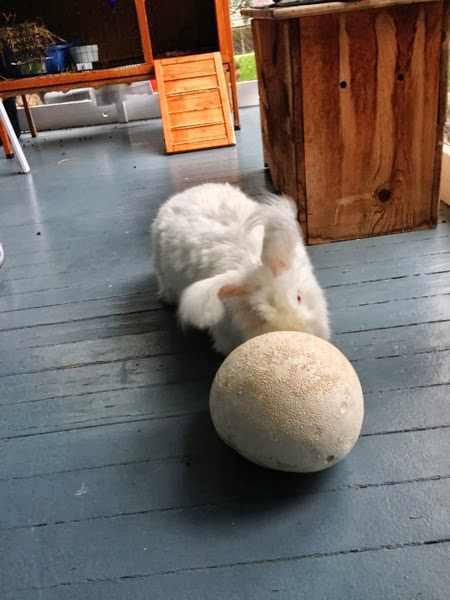
I know, after being gone from here for so long, you'd think I'd come back with something really profound. But when I think of it, what is not profound about this very strange and rather rare mushroom? If you are on a hike in the woods and happen to glance off into the undergrowth and notice a large round white object it is probably a Giant White Puffball. It is so startling, you can't help but think that some kid lost a soccer ball. If you can find it early on, when it is still young and dense, they are delicious. Along with morel mushrooms, there is no mistaking them for anything else. Seriously. You would be safe eating them. Their pure white flesh tastes a little like mild cheese. 

Anita found this one and brought it home. When I first saw the photo, I thought you could easily mistake Honeysuckle for a miniature bunny who was examining a button mushroom. (Denis and I are not home right now - having taken some vacation time to be on the North Shore - our favorite spot for decompressing in this starkly beautiful place.) She reports that last night she made a brown rice risotto with kale and mushroom and it was delicious.

Mushroom

North Shore


Friday, September 20, 2013

God Answers Denis' Prayers about Wild Mushrooms

Mushrooms Boletes
Ceps?

So, last week among the mushrooms springing up beneath the thickets on this lonely point where we were staying, I found what looked like the Cep, also known as the King Bolete. These large, brown mushrooms are found and eaten everywhere in Europe. As an American I've felt lame and ignorant when it comes to harvesting and eating what is so OB-vious to other people everywhere. And FREE! There are some species I know beyond any shadow of doubt. Like Morels which, if you know me you are sick of hearing about. The Common Puffball is pretty safe as long as you don't confuse it with a very young mushroom of another sort in its early stages. Once, I even found the Giant Puffball. They are so enormous,I swear when I saw it in the woods from a distance, I wondered who on earth kicked a soccer ball to here!? It deteriorated before I could eat it all.
Anyway, I was relying on some of my guides to help me figure out what is edible and what is not. Two of my favorite guides:
Edible Mushrooms by Clyde M. Christensen  He is a no nonsense kind of guy who believes the best way to harvest edibles is not by knowing all the poisonous ones - there are too many - but to know the edible ones so well you will never make a mistake.
Mushrooming Without Fear: The Beginner's Guide to Collecting Safe and Delicious Mushrooms by Alexander Schwab is a fantastic guide. He show-cased some of the most common edible mushrooms and each species had many photos and characteristics to look for so you would never, ever mistake them for anything deadly. I trusted him. Even when I read:  "the white network on the stem of the King is very clear and makes identification almost foolproof." It is that "almost" that is a little unnerving.
After fingering each page of his book, I couldn't stop myself gathering a whole lot of the best examples, Ceps, Birch bolete, Larch Boletus, Puffballs. Then, I brought them inside and prepared them for supper.
Many mushrooms
Ready to clean

Mushroom Mix
Mmmmm!

I peeled the caps - they all had a membrane that was easy to pull off - cleaned them, dried and sliced them. Sautéed them in a little butter, added chopped garlic, chicken broth and white wine and commenced reducing the liquid. The aroma filled the cabin and I couldn't wait.  As they simmered away, I thought, "I'll just take my iPhone and google poisonous boletus because, just in case. As you probably know, anyone who is a situational hypochondriac should stay away from Google. So I found a ton of sites that mentioned that some Boletus are difficult to identify and some species might make you sick especially if you are elderly or a little unhealthy or just don't care to risk 48 hours of your life blowing out your intestines.
Denis was reading on the porch when I rose from my chair and confessed that after a little more research I didn't think I should take the chance. His relief shocked me. I hardly believed him when he said he had been praying I WOULD NOT even taste them. He insisted he was sincere. If he had tried to stop me, I suppose I would, of course, have eaten the whole mess. This is not a virtue.
I stepped into the bathroom for a minute and when I came out the pan was empty. Anita had already dumped them in the trash.
I need a living mentor. Where is she?!

Thursday, September 19, 2013

Stink Horns and Fly Agaric Mushrooms

On this small point of Wisconsin land that gently bulges into Pike Lake there must be several dozen species of trees from larch to maples. Last week something in nature aligned with trees, weather and decaying earth because the ground gloriously released hundreds of mushrooms. Everywhere. Some as big as dinner plates and as soft as Nerf balls, others so tiny and camouflaged you would never spy them unless you stared at your feet for a hundred years.
WI Cabin
Pike Lake Cabin

Boletes
Boletes Not sure what kind. Perhaps "Red Cracked"
I saw lots of boletes - distinguished by a hundreds of tubes on the underside giving them a sponge-y feel and appearance. Dozens popped in the grass just outside the cabin door - golden nuggets blending with the yellow leaves that are beginning to fall from the maples. I was sure they were  larch boletes and I collected them, determined to eat them later. We found several fairy rings - mushrooms that are supposed to be delectable, but we decided we needed more information on them.
Fairy ring mushrooms
A Fairy Ring

Fly Agaric 1
Immature Fly Agaric (Aminta muscaria)

Fly Agaric 2
Huge!!

Two of the most fascinating species (I can't identify that many) were unmistakable. Aminita Muscaria - the beautiful poisonous Fly agaric. I love finding this legendary mushroom of fairy tales and wood elves. When young its round cap varies in shade from orangey-red to straw yellow and sits perfectly round on a white stem. The cap is covered with white or pale yellow warts. As it matures it flattens and broadens into a plate that can range from three to ten inches across. It attracts flies who lap up the sticky surface with their little tongues, go into a dizzy dive and fall dead. Apparently there are folks in Siberia (and who knows where else) who risk enjoying the hallucinogenic properties and live to tell. But I guess its a gamble, not everyone survives. So how good could the trip be? Or how bad your life? (I never fail to exclaim.)
Stinkhorn
Stinkhorn Mushroom

Denis alerted us to a stinkhorn mushroom. Yes, it stinks and yes, it's shape is disgustingly hornish. He had wandered over to a bench near the water and got a whiff of something so revolting he looked around thinking he had stepped on a rotting carcass. As he peered into the grass he noticed an odd-looking mushroom. It was about six inches long and the cap was covered in an olive-green evil-smelling slime. As Denis wafted the air my direction I took an involuntary step back. By the end of the day it was covered with flies and black beetles fighting for a place at this slimy table.
I never fail to wonder at the strangeness of mushrooms. At their mycelium which lurk unseen in rotting wood, garden soil, even in the foundations of our homes, at their fruiting bodies suddenly appearing out of nowhere in mind-numbing varieties. That they can be literally drop-dead gorgeous and kill you in a single bite or be so delectable you crave them like crack cocaine. All these things are why I am bewitched by them and that God should make so many! As many as the stars, perhaps.

Wednesday, July 17, 2013

Cuckolded

Cuckold  ˈkəkəld, -ōld ORIGIN: late Old English, from Old French cucuault, from cucu ‘cuckoo’ (from the cuckoo's habit of laying its egg in another bird's nest). The equivalent words in French and other languages applied to both the bird and the adulterer.
     For the second time this summer a pair of purple house finches have built a nest in the corner of our front porch. They are hidden up there on the ledge where we have placed a shallow clay pot liner. We love the little parents who scold us when we walk out to get the mail. They fly to the crab apple tree and say, cheee, cheee, cheee. Their first nesting hatched three babies, so we were shocked when this time around there were seven eggs! An ominously large brood for a little mother to raise. But wait! When I looked more closely (we lifted the liner down for a few seconds to peek in because we’re curious, and then quickly replace it before the parents die from anxiety.) Suddenly, I realized that two of the eggs were not like the others. (I could hear that Sesame Street song in my head urging me to decide which one was different.) I looked again. Two were noticeably larger and different in color. More brown speckles. I know that Cow birds are like the English cuckoo bird playing a nasty bully-trick on honest little birds, sneaking in and dropping a giant egg or two that when hatched will put to death the natural children, and with their voracious appetites, will stress the parents who can’t seem to tell the difference between the interlopers and their own poor, starving babies. So the cuckoo is the source of the word “cuckold.” The story of the sailor who has been away at sea for over a year, who returns home to find his wife has a baby. Thus the saying emerged: “I’ve been cuckholded!”
     I didn’t expect to find the cowbird in an urban setting. At our house? I have no problem interfering with their ugly agenda. I remove the two eggs, take them to the driveway and smash them on the cement, heartlessly killing the little alien invaders. I’m not looking too deep for meaning here. Or am I? Why should I turn every story into a Me Story? Unless God means me to reflect on this passion I have for rescuing. Maybe removing cuckoo eggs is not what I’m supposed to be doing. Maybe I’ve misunderstood the difference between selfishness and stewardship? Perhaps my zeal for finding and saving has more to do with my own needs than it does for helping others? This might make more sense if you knew I was struggling with boundaries. More wisdom to learn, even at my age.
Finch Nest
Finch nest on Toad Hall porch.


Cowbird Eggs
Cowbird eggs in hand.


Cowbird eggs in finch nest jpeg
Cuckolded!


Tuesday, June 11, 2013

God is gross

Honeysuckle wool
This gives you an idea of how long her wool can get.

When Honeysuckle's principal owner, Anita, is gone, seeing to her health and well-being as a pet falls on me, though Denis is good to bring her dandelions in summer and kale in winter. As we all know, sometimes our pets purposely do things that are disgusting - I'm thinking about how our dog used to find things to eat on the boulevard during walks; things I don't even want to know what they were; things I could't stop him from gulping down however quickly I jerked back on his leash and yelled NOOOO. Or, and this is true of any animal we may be responsible for husbanding, like cows or goats, …. or it may not be anything they can't help, like musky glands or baby lambs stuck in birth canals. Or even the normal digging, biting power cords, chewing one's home to bits.

Anyway, I was thinking about things like this as I had Honeysuckle positioned upside down on my lap because her long wool sometimes needs to be trimmed away from certain parts of her anatomy - she had a buildup of matted and clotted fecal matter that needed to be carefully and meticulously cut away. She lay patiently on my lap as I snipped away and thought what a nasty mess this was. But as usual, I couldn't help thinking about the deeper meanings our encounters hold for us if we think about them for more than two seconds. How good I felt helping this innocent animal with something she couldn't do herself. Although it was stinky, it felt right and proper and grace-giving - like in that moment I was doing exactly what God told us to do when he blessed our Mother and Father in the garden and sent them out to take care of the earth.

Then as I was reading and reading and reading, because it is such a looooong book that requires eating in small bites, The Letters of C.S. Lewis to Arthur Greeves, I came across a letter on the very topic of how we can be repulsed by the natural consequences of being a natural beast, and thought how clever I might have been to be able to scold C.S. Lewis for his scruples.

"Physical disgust is a sensation which I have very often and of which I am always ashamed. If one lets it grow upon one it will in the end cut one out from all delighted participation in the life of nature. For God is gross and never heard of decency and cares nothing for refinement: nor do children, nor most women, nor any of the beasts nor mien either except in certain sophisticated classes. And yet it's hard to feel that the faculty of disgust is a sheer evil from beginning town. I don't know what to make of it." (#146, p. 371)
I couldn't agree more. 
Honeysuckle on lap
Do even part-time owners look like their pet? Here we are getting ready for a clipping.

Tuesday, May 14, 2013

Wood Anemones


Wood anemones first flower of spring

Peeking through forest litter
     Yesterday I was sitting on a bench at the edge of a river bluff. Elms and lindens soared up from somewhere from way down below, their skeletal ribs towered above me and gently waved their hairless crowns as if pushed lightly pushed by a spirit. To my left a white pine soughed in the wind, creaking softly. Bright green moss cushioned the floor from my feet to the sharp edge of the cliff where it dropped a hundred feet to the river below. I was listening to hairy woodpeckers drumming on deadwood, tapping out mating calls in woody rhymes. How, I wonder, can anything beat its head that fast and hard against solid wood and survive? An eagle silently soared past at eye-level following the twisted river. She glanced at me with a severe look. I nearly overlooked a tiny wood anemone. I could have left without ever noticing – so shy it is. Sometimes its called a windflower because a windy day can cause it to open its sepals that look to me like seven tiny petals unfurling around a furry yellow center. But botanists say they are sepals not petals. When I looked more intently, then I saw anemones everywhere in small patches along the very path where I’d walked, peeking from brown litter and steep ravines. White clusters, some with the softest blush of pink. These are the first flowers of spring that took so long to arrive this year. I think sometimes its just okay to be small and hidden, quietly blooming, doing your job before the big guns come and steal all the sun and air. Hoards of bluebells. Extravagant wild iris. Carpets of wild garlic.
Today I hope you are blessed by something elfin and beautiful just doing its job.

Sunday, March 10, 2013

Time to change

-->
It is snowing this morning. The first day of “Daylight Savings.” Daylight Time used to change when Spring was firmly established in flowers and light. Today, ironically, it is still winter. Snow falls straight down in heavy-cotton chunks. Theirs is a quiet, passing beauty. The kind of snow-fall that doesn’t last. Quickly it fades to small flakes and then disappears altogether.
I am thoughtful this morning. Considering changes. Time, weather, place. What to make of unwelcome changes?

Yesterday, driving from Lincoln to Rochester meant passing through most of Iowa on interstate highways. First miles and miles east to Des Moines on I-80 and then up, up, north and north through the “fruited plains” on I-35 until at last the bluffs of southeastern Minnesota gently rise.

About thirty miles west of Des Moines traffic suddenly slowed, came to a stop. We could see the road ahead was clogged with cars and trucks idling in the rain. An accident.  Someone’s tragedy unfolding far ahead; who we would never know. As we approached the standing point, some vehicles were making a k-turn, passing us on the shoulder and exiting the wrong way up the on-ramp. One questioning glance from Anita, and we were doing the same. It was a satisfying crime. A justifiable change of direction. We quickly followed a line of traffic heading cross-country. Along the back roads, we had time to call up Google Maps and decided to follow the perfectly paved Iowa county roads, straight and smooth, skipping Des Moines and Ames altogether.

A map of Iowa hints at its history – a perfect grid of right-angle roads. Rich, black soil precisely divided into sections worth millions. One mile on a side, 640 acres within the square. Farmland that made the lives of men and women who raised crops and animals to feed hundreds of others. Often there is still a stand of old trees on one corner of a section, remnants of a homestead, a house that might still be lived in, if it’s lucky, but the out-buildings –  the out-buildings. All dying, sinking back into the ground. Barns three stories high with an elevator still sitting beneath the haymow door as if one day the farmer was raptured, or died or moved to Arizona. Round barns, barns with graceful cupolas, hipped roofs, angled roofs, stone, oaken, bricked, square, reflecting styles of German, Norwegian, Dutch immigrants.
Iowa barn in winter
Not as many of these places are seen from the heavily traveled interstate, but on back roads they never leave your sight. County after county the quiet is eerie. In the stillness of winter the machines are gone, the land is dark, the buildings are broken, blackened, faded red. Granaries, barns, coops without an animal or human in sight.

Perhaps one reason American factory farming troubles me is because I feel alienated by it. I want to be wholly restored to land and creation. I want us to be careful caretakers of, not just the earth, but of people. I mourn empty places that were once alive with chickens, cows, horses and pigs. I want to repopulate them with children and dogs and tire swings. Restore a garden. Perhaps it is true Home I wait for – that impossible place of meaningful work and unbroken restoration God will bring about one day.

Tomorrow, I will be more settled. More distant from dying places I can’t fix. I will focus on my desk and maybe I’ll think about the small patch of urban earth outside our back door. Flower and seed catalogs are here and we need a few more climbing roses and stone walls for them to thrive upon.


Tuesday, May 17, 2011

Sustaing fantasy in the Ozarks


Reflecting on my life-long fantasy of living somewhere in the country. Perhaps more extravagant than bees, what about alpacas or angora rabbits? Since Sue Hubbell wrote the following in 1983 there may be permanent changes ala Winter's Bone even in the Ozark landscape. Sad to say.


"I find the hopeful bee-agribusiness visitors touching and appealing; many of them are young and they bring out the mother in me. They are often working at dull jobs they do not like, and the idea of owning a bee farm in the country is a sustaining fantasy. I try not to discourage them, but sometimes I have to. Almost any kind of farming dooms newcomers to bankruptcy these days, particularly bee farming, because of the market conditions. About the only quicker way to go broke right now is to raise pigs, so when a man came to seek my advice a month ago and told me he was ready to spend ten years’ worth of savings from a factory job to buy a farm where he would raise bees and pigs, I had to admit it was the worst idea I had heard in a long time. He went away saddened; I don’t know whether he bought the farm or not.
            The Ozarks, wild, undeveloped, inhospitable, keep being discovered. A lot of people who figured it was better to be poor in the country moved here during the 1930s; others, richer, thought FDR was the devil incarnate and wanted to put their wealth in land before he could take it away from them. Since then waves of people who find the cities too complicated have come here, meaning to lead lives of simplicity. What they have not yet discovered is that a life is as simple or as complicated as the person living it, and that people who have found life in the city over-whelming will find it even more so here, where it is much harder to make a living. When a person has money coming in regularly, his mistakes may make hi unhappy but they do not threaten his survival. Here, where there is little money, every decision counts and there is no room for mistakes."

* Bees in pic belong to John Eddy who keeps bees in the very urbane, urban Cos Cob, CT

Saturday, January 15, 2011

Gambel’s Quail


My favorite desert bird. Monogamous. Ground runners. Found in coveys. The male dude sports an absurd single feather that springs from his head. They are shy and cautious and quickly run away from you disappearing over the wall or through the underbrush. But when we visited the Phoenix Botanical Gardens, being used to people they came close, right under our chairs, at the outdoor eating area, waiting for the chance crumb (“Do Not Feed The Wildlife” but I’m a messy eater. Some things can’t be helped even if they’re illegal). I got one not-so-good shot, and a few seconds of their tiny peeping voices. I love them.


The next day as Peggy and I had a last breakfast together she had a little gift by my plate – a tiny Gambel’s Quail fashioned from a gourd. I’m delighted to bring him home. Reminder of God’s humor – the delight of certain creatures that spring from a barren desert to give us the gift of joy. I mean, not all do – consider the javelina or the rattle snake. But now this little gourd also reminds me of the long friendship we have fashioned through years of traveling together.
Henri Nouwen writes “Friendship is being with the other in joy and sorrow, even when we cannot increase the joy or decrease the sorrow.”  We’ve known this and it gladdens my heart.


Tuesday, July 20, 2010

Sleeping in the litter


Saturday: in which I gather neglected thoughts and projects, and wonder if I should find the surface of my desk one of these days. Nawwww. Everyone has departed – Sandy returned to New Zealand yesterday morning having been here since the 4th of July. Anna Dahl has gone home to Iowa for the weekend – she’ll be back Sunday night to do her shifts as a nurse at St. Mary’s. Anita went to Madison to meet Marsena and see an outdoor Shakespeare play in the evening and hang out for the weekend. We are bunny-sitting and eating Farmer’s Market Golden Baby Tomatoes by the handful.

Honeysuckle is Anita’s angora rabbit who shares, nay, rules our screened-in back porch. She personifies the moniker “Dumb Bunny” but we appreciate her dumbness as after all, God’s made her that way. Unlike many of us, she is comfortable in her creaturely-ness. She sleeps in her litter box with no apology, nibbles Denis’ slippers, (he lets her for heaven’s sake), hops up on the shelf to eat a bowl of chips, gnaws the siding off the house (we put a stop to that!) and steadfastly refuses to acknowledge my presence unless I have a blueberry or a grape.

I never quite get it. At the same time I don’t mind the reminder – it’s the small parts of life, the insignificant, the common that become the holy parts – the places where God waters and feeds us.

Wednesday, January 27, 2010

Closer to creation

The power of observation to capture an almost nothing: A seventy-six word sentence neatly followed by one much shorter. Almost perfect.

In the palm of her hand was what looked at first like a shred of whitish dust but on closer inspection turned out to be a little downy feather, no more than an inch long, with a needle-thin white spine out of which grew first a nimbus of fluff and then, for about a third of an inch, neatly tapering white filaments clinging to one another with their minute jellyfish barbules to form a triangular tip. Certainly it looked closely related to dust, and by that branch of the family a cousin of absolute nothingness.

From It’s Beginning to Hurt by James Lasdun