![]() |
| Male Cowbird |
Wednesday, August 31, 2016
Stop feeding the monster: Bird lessons in life
Thursday, July 31, 2014
You aren't the first to get there
Perhaps everyone else is aware of the symbolism embedded in the Chinese character that is translated "to listen." Not me. I only recently learned about "ting." It is very interesting. Okay, more than that. It is fascinating and attractive.
On the left, the ears are prominent. The eyes are on the right looking out at you. The straight line beneath them signifies intense focus. And beneath that is the heart with the tear-like drops. Together, they express an action that requires more senses than just the ears, and becomes more powerful and more meaningful than just "listen" as we would say in English.
Often I listen more with my mouth than any other body part. When I happen on a person in need - it could be a friend, a relative or even a stranger - my first impulse is to give words. To let them know I understand their difficulties and to offer hand-me-down thoughts from wherever I have gathered them. It is partly a lunge to let them know I "get them." The motivation for this flows from a polluted spring - I feel a guilty responsibility to fix what I see. If I don't or can't, it may indicate my own deep failure to be someone who heals and helps. This is not exactly empathetic.
I've been learning a good deal about listing from Zack Eswine, author of Sensing Jesus. He writes:
"In Jesus we learn that we are never the first to arrive on the scene. We enter the moment quieted to learn what has transpired there before we arrived. What has God been doing prior to our arrival? Once there, what is his intention for our presence? Our nervousness, our desire to do well, our past wisdoms and successes, our longing to have nice things said of us, or our leftover feelings from how we just handled our spouses or were handled by our deacons - these ought not guide our words and actions once we are on the scene." p. 201.
Never the first to arrive on the scene. Not quite how I pictured it. There's something very freeing about that.
Thursday, March 6, 2014
Forgive yourself
I’ve had a little vacation from my computer when I sent my old one off to Ed in Florida. Lucky me, he transferred all her data to a new one - as long as Ed is around (thank God he is doing pretty well and about to be another “first” in getting a new-fangled treatment for stage IV metastasized prostate cancer) he still keeps our machines rotated and up-to-date. It felt good to have it gone, gone, gone. Like I was free from one of those enslaving robot pets that quack for mama duck all night. I looked at that empty spot on the desk and was happy not to hear the little ploops announcing the arrival of messages. It reminds me that there were days back when, when I still knew how to use paper and pen.
Now she's back. I call her Jane. I don’t know why. Perhaps it’s Calamity Jane I’m thinking of - blazing fast and easy on the eye. I quite like her, but I’ve still been avoiding her, distracted as I am about selling, moving and buying the next place in life. It’s the best excuse I’ve had for not writing in about a hundred years. Don’t bother me, I’m sorting moldy tub toys that haven’t been used since my 36-year-old daughter was a baby. Go away, Denis and I are in intense and delicate conferences about finances and futures.
When pressure mounts to brain stroke intensity, I feel like beating myself up all the way from here to Glen Allen, Alaska. Then I realized something important about forgiveness. You need to forgive yourself, Einstein. Stop your ridiculous self-abuse.
I came across this by Ann Patchett and I’m pretty sure it applies to a lot more than writing:
Forgiveness. The ability to forgive oneself. Stop here for a few breaths and think about this because it is the key to making art, and very possibly the key to finding any semblance of happiness in life. Every time I have set out to translate the book (or story, or hopelessly long essay) that exists in such brilliant detail on the big screen of my limbic system onto a piece of paper, ... I grieve for my own lack of talent and intelligence. Every. Single. Time. Were I smarter, more gifted, I could pin down a closer facsimile of the wonders I see. I believe, more than anything, that this grief of constantly having to face down our own inadequacies is what keeps people form being writers. Forgiveness, therefore, is key. I can’t write the book I want to write, but I can and will write the book I am capable of writing. Again and again throughout the course of my life I will forgive myself. - Ann Patchett, “This-Is-Story-Happy-Marriage"
For me this translates to: I grieve most about lack of diligence. I can’t or don't write as much as I would like, but I can and will write what I can when I can. Does this make sense?
Thursday, February 6, 2014
Do Nothing
I have a response pattern firmly woven into my amygdala. It loves to presuppose that Margie should never make a mistake. However small it might be, you are not allowed to get it wrong. If the thing is big, involving another’s well-being, lots of money, losing your keys, or moving your house and job from here to there, well then, there will be hell to pay if you get it wrong or can’t fix it. Matters of less consequence are not exempt from punishment.
Some would say when mistakes are made they are accidental. Circumstantial. Just life. Maybe, but lately I’ve come to believe God is messing with that organ in my brain; perhaps it should be called my heart. Or my spirit. Whatever, where ever it is, He is in that place where the real me dwells beneath miles of protective layers and he allows me to make mistakes. Sometimes he’s there with a wrecking ball trying to get my attention, other times with an instrument so delicate I barely feel the exposure of this ill conceived notion that whatever Margie does, must be done perfectly.
What happened yesterday will probably seem inconsequential to you. Not to me.
I was excited that it’s time to replace my aging computer with the new MacBook Pro Retina Display. Ed sent me the link and told me to go ahead and order the computer and a warranty and have it shipped to him for set-up.
1. I ordered the wrong computer.
2. I forgot to purchase the extended warranty.
3. I was dropped several times before I finally got the warranty purchased. When I purchased it, it was, of course, for the wrong computer.
4. When the receipt was emailed I saw I had even accidentally ordered an extended warranty for a computer I knew I wasn't getting.
5. By the time Ed figured it out, the wrong computer had already been shipped with the added cost of a warranty for a computer they hadn’t shipped and I wasn’t getting anyway. Do you understand this? Good.
It is the most mystifying thing to be a person who can get so many things wrong in one go. It is also humiliating. Shameful. It was time to beat myself up.
Suddenly I decided I’d had enough of that. This is who I am. A person who makes mistakes. Even sinful mistakes. Not one of my weaknesses is a surprise to God. (Not to Ed or to you either.) Being a person who tries to control every thing and every one and fails at the simplest thing and yet is still loved by Jesus? That’s not bad.
In a book I’m reading slowly these days - Barbara Duguid writes in Extravagant Grace: "Paul’s description of himself as chief of sinners (see I Tim. 1:15-16) is not some charming attempt at humility and self-abasement; it is the absolute, glorious truth. We are all frail and fragile children who sin a great deal in our disobedience, but who also manage to sin a great deal in our best obedience as well. Discovering this truth and growing to love it can be one of the most powerful and joyful motivations for change that God ever invented, but it seems that few Christians today ever get there. They have such a hard time giving up their great expectations for themselves and others, and they are left spinning aimlessly in cycles of fear and shame as they try desperately to impose those expectations on the recalcitrant world around them."
May God continue to hammer at my heart. I want change. I want/need joy.
Wednesday, November 6, 2013
There are Chickadees
One thing I've always wished I could experience is to have a wild bird eat from my hand. I've always loved chickadees - they are so small and cheerful. I've heard they aren't too difficult to entice, just stand outside until your hands and feet are frozen stiff and hypothermia followed by rigor mortis sets in.
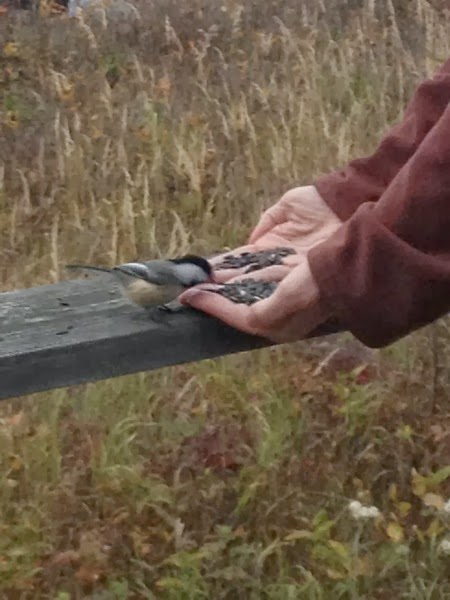
Last week I did it. I stood on the deck of the cabin. Waiting, waiting. Waiting for them to overcome their fear of me. There was a flock of them flitting about because they'd already been careening in and snatching from little piles of black sunflower seeds I'd scattered on the railing. When they were nearly gone, I posted with my hands cupped, those seeds a little siren song seducing them.
I was about to give up when, to my surprise, the nuthatches came! Hopping along the rail, making little chirrups, clutching my fingers with their tiny feet, sorting the seeds,with their needle-nosed beaks, tossing away several before finding the exactly right one. I was enthralled. Finally, a brave chickadee skidded to a stop about six inches away. She arched her head, eye-balled a seed, hopped on my thumb, grabbed it and arced away. I could feel the tiny draft of her wings as she pulled up. They kept coming. I tried not to laugh for the joy of them.
I just heard about a woman with four young children who has Stage IV breast cancer. As we know, "there is no Stage V." Her heart bursts and breaks with love and longing for her children and her spouse. She strives to remain in Christ during her long sleepless nights.
So, I wonder. Why am I blessed with chickadees and nuthatches? There is no short answer to this. It seems that as long as I live I will need to review questions about suffering and persevering. I read C.S. Lewis. Edith Schaeffer. J.I. Packer. Others. And am temporarily satisfied, but is it my memory that has so many holes in it that I must return again and again to be reminded? I think so. And, I also turn Scriptures that assure me that God "prepares a table before me in the presence of my enemies." (Ps. 23) And further, "goodness and mercy will follow me all the days of my life." So, God, please bring comfort to that young woman. Prepare a table for her that sustains her through the valley of death. And thanks for the birds you brought to my hands - they were goodness, a kind of evidence that you have not abandoned us or your creation.
| Handfuls of goodness |
Monday, August 19, 2013
Bringing nature home
I don't know much about flower arranging. I mean what is this or that style called? Japanese minimalist? Polly's posies? I don't know. I only know the names of a few flowers and shrubs. I'm likely to describe a licorice plant as that plant with the thick, viney, trailing stems with fuzzy, kinda white-ish leaves. I just put things in vases. I learned by looking through this book that my style is a meadowy look - bouquets of colorful shapes and sizes, crammed together, over-flowing - tumultuous, bountiful. Rather like my cooking that I call Peasant Style; pretty simple and a lot. But there are other ways.
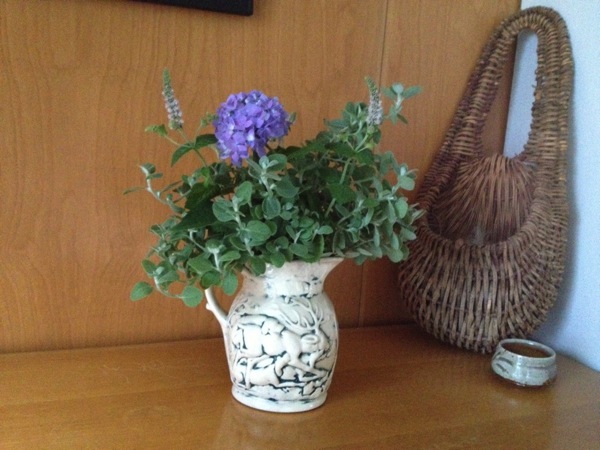
The dictionary reminds me that a talisman is an object thought to have magical powers. This book inspired me to take a walk around our yard looking for magic. What could make simple beauty if I brought it inside? What could I find that was simple, graceful and made from less rather than more. I wonder what you have outside your back door? I stole a single blue hydrangea from Anita's prized shrub. To go with it I clipped some licorice plant stems from overgrown pots. The faint white shades of the leaves put the single blue flower in relief. Three mint blossoms on arching stems gave it a little lift. Their soft, brush-shaped flowers contrasted with the precise hydrangea petals. I pulled an antique water pitcher off the shelf for a vase. I left it here on Anita's bureau.
I was happy with this small way to express joy. At the same time, flowers make me sad because they don't last and I think a lot about this. They drop messy pollen all over the place, their petals shrivel and fall off, and have you ever smelled flower water? It STINKS like dog shit after a few days. I've spent a long time thinking about what it means when Isaiah says "The grass withers, the flower fades," (Is. 40:8) and I know he is talking about us. Human lives. We are so here for a little while, then we are gone. This is distressing. I used to wonder, then, what it meant that when Isaiah finishes the thought with "But the word of our God stands forever." Is that supposed to comfort me? Well, yes. Yes it should. That's because, as so often happens with Scripture, it coheres. It interprets itself. So when Peter writes: "For you have been born again, not of perishable seed, but of imperishable, through the living and enduring word of God. For, 'All people are like grass, and all their glory is like the flowers of the field; the grass withers and the flowers fall, but the word of the Lord endures forever.' " (I Peter 1:23-25)
So yes, flowers have their fleeting pleasures with reminders of a world beyond our doors and it is no small thing to bring them in and to love their glory. We can, I mean we are allowed, to think of them as we ourselves fade and we are no longer at the peak of our game, as if I ever was, but I have this: this promise, because of Jesus, I am re-born of imperishable seed and one day I shall be restored to a kind of eternal beauty. He will make it so. Really, he will. My faltering steps rest on it.
Tuesday, August 13, 2013
Johnny Cash - too many "I's and me's"
From an interview by The Daily Beast with record producer and co-founder of Def Jam Records, Rick Rubin says:
On our first album, there was a song he wrote, I can't remember which one it was, but I listened to it and said, "Do you think you could take some of the 'I's and 'me's out of it?" And he thought about it and he was like, "Yeah, I think I can do that." And he did. So 10 years later, I'm visiting him in Nashville. He's in a wheel chair. He's blind, pretty much. It felt so awkward. So I said, "What have you been working on lately?" And he said, "I've been working on using 'I' and 'me' less." And I said, "Really?" and he said, "Yeah. Remember? You gave me that comment on the song? That's what I've been working on." Incredible. He didn't mean it in the context of songs. He meant it in the context of life.
Thinking recently about my own "I's" and "me's." Until we die - our enduring Holy War.
Wednesday, July 17, 2013
Cuckolded
For the second time this summer a pair of purple house finches have built a nest in the corner of our front porch. They are hidden up there on the ledge where we have placed a shallow clay pot liner. We love the little parents who scold us when we walk out to get the mail. They fly to the crab apple tree and say, cheee, cheee, cheee. Their first nesting hatched three babies, so we were shocked when this time around there were seven eggs! An ominously large brood for a little mother to raise. But wait! When I looked more closely (we lifted the liner down for a few seconds to peek in because we’re curious, and then quickly replace it before the parents die from anxiety.) Suddenly, I realized that two of the eggs were not like the others. (I could hear that Sesame Street song in my head urging me to decide which one was different.) I looked again. Two were noticeably larger and different in color. More brown speckles. I know that Cow birds are like the English cuckoo bird playing a nasty bully-trick on honest little birds, sneaking in and dropping a giant egg or two that when hatched will put to death the natural children, and with their voracious appetites, will stress the parents who can’t seem to tell the difference between the interlopers and their own poor, starving babies. So the cuckoo is the source of the word “cuckold.” The story of the sailor who has been away at sea for over a year, who returns home to find his wife has a baby. Thus the saying emerged: “I’ve been cuckholded!”
I didn’t expect to find the cowbird in an urban setting. At our house? I have no problem interfering with their ugly agenda. I remove the two eggs, take them to the driveway and smash them on the cement, heartlessly killing the little alien invaders. I’m not looking too deep for meaning here. Or am I? Why should I turn every story into a Me Story? Unless God means me to reflect on this passion I have for rescuing. Maybe removing cuckoo eggs is not what I’m supposed to be doing. Maybe I’ve misunderstood the difference between selfishness and stewardship? Perhaps my zeal for finding and saving has more to do with my own needs than it does for helping others? This might make more sense if you knew I was struggling with boundaries. More wisdom to learn, even at my age.
| Finch nest on Toad Hall porch. |
| Cowbird eggs in hand. |
| Cuckolded! |