Wednesday, August 22, 2012

The givenness of everything


Denis and I think, speak, try to live with the understanding that all we do is whole. We are not Christians here and over there we are an athlete, here we practice our faith, here, for the moment, I am buying spices or reconciling my bank account. Same with writing.

Posted on the Kalos Press blog:
Richard Doster helps me think about what this means for my own writing and faith as he points to so many writers of great literature whose faith was integral to their life and living:

“In speaking about life and faith, Marilyn Robinson declares, ‘I’ve never found them to be incompatible …. Frankly, historically speaking, a great deal of English language literature is generated directly out of religious thought and religious erudition.’ Then, with words that bring O’Connor and Percy to mind, she said, ‘For me, a religious mindset creates a habit of scrupulous inquiry relative to virtually everything ….’ She explained to Lanpher [Katherine Lanpher was interviewing] that, ‘… everything has religious significance. It’s not as if I go from one area of interest to another,’ she said, ‘they’re simultaneous for me.'

“From Robinson, throughout the whole of the conversation, there’s not a syllable of defensiveness; there’s no awkwardness, no need to shy away from anything she believes. And from Lanpher, there’s only respect for a great writer.

“The conversation later veers down this charming path, as the Pulitzer Prize winning Christian so casually explains to the secular interviewer on a nationally distributed podcast that John Calvin is 'cool in a lot of ways. If you read his sermons on the 10 Commandments,’ Robinson explains, ‘they’re absolutely beautiful, profoundly humane interpretations of things that many people find forbidding.’ She continues, talking about how Calvin situated sacred and human experience in the mind and in perception, and about how she feels indebted to the 16th century reformer for his understanding of, 'the givenness of everything.' 

Kalos Press reprinted this article with permission from byFaith magazine.


Saturday, August 18, 2012

Putting it away


Shredded cabbage, salt, natural fermentation, glass jars equals sauerkraut
As I begin today I am keeping in mind that tomorrow is Sunday and it needs to be a day of rest for me. It isn't as much obligation as necessity. I am tired. When I say this, I am aware that some schedules don’t allow Sunday to be that day for you. I understand. It often doesn't work for me either.
Today there are some letters that must be written. A bill to pay. A chair that is being taken apart to be recovered. It is in an ugly state of undress right now with many, many more staples to wrench out of the wood frame before a new fabric can be put on. I must make several phone calls I’ve been putting off. I have a large bowl of shredded cabbage that has been working overnight. Today it needs to be put in sterilized jars to become sauerkraut. Most urgent of all there is a box of perfectly ripe Colorado peaches (the best I’ve tasted in years!) that need to be dealt with. They can’t wait. So peach jam. Peach/Hot pepper jelly. Frozen peaches for smoothies. A peach cobbler for supper.

But tomorrow, I’m putting all that away from my hands and mind. I will be attending church, napping, reading a book, going for a walk, and snacking from the refrigerator and pantry.

Ruth Haley Barton puts it well, “The first order of things is that we are the creatures and God is the Creator.  God is the only one who is infinite.  I am finite, which means that I live within physical limits of time and space and bodily limits of strength and energy.  There are limits to my capacities….I am not God.  God is the One who can be all things to all people.  God is the One who can be in two places at once.  God is the One who never sleeps.  I am not.”

Saturday, August 11, 2012

Make Classic Crock Pickles


 Cucumbers are sneaky, secretive. We had a plant, just one, growing beside our back steps this summer and at first it was a lazy little vine that made blossoms but no fruit. The flowers shriveled and dropped. Turned out the blossoms needing pollinating. There weren’t enough bees around to do the job. Anita showed me how to take a tiny paint brush, dip it into a male blossom and then pass the goodness into a female. She told me how to tell the difference between them, but I didn’t get it, so I stabbed every one I found for the week she was gone. Apparently they figured out their chemistry because this little vine has grown big. Big enough to cover the oregano, wrap around the sedum and climb the bee balm. Meanwhile it is producing handfuls of sweet, crisp cucumbers.

A few manage to hide behind a leaf for an extra day or two until you find them grown to the size of a man’s tube sock. I swear they can do this overnight. Grow that big. What  to do with them?
Make crock pickles.

I often crave pickles, and as I handled these big ones, I though of the old wooden pickle barrels that used to sit beside the cash register of every general store in America. What I didn’t realize is that they required no refrigeration because the natural fermentation process preserved them.
You can make your own crock pickles quite easily and the recipe can be tweaked a little to get it how you them.

This is a method of preserving food that is being recovered. Cucumbers are especially well adapted to this kind of fermentation, though other vegetables like onions, carrots pepper are good, too. If you’ve had to do a course of antibiotics lately, more doctors are now suggesting you replace all that good bacteria in your gut with probiotics. Millions, billions of those teeny, tiny seething little organisms that help us digest food and fight off evil are now dead along with all the bad ones. Our American diets do not include enough of the beneficial bacteria found in yogurt and pickles and fermented foods. This could be a start.

So, if you have a few extra cucumbers, now is the time. You can make a small batch, enough for two quarts. Whet your appetite, pass one of these to a friend, a kid, a spouse and you may be rewarded with more than just a little help for the bacteria farm growing in your gut.

Classic Crock Pickles
(makes 2 Quarts)

2 lbs. pickling cucumbers or spears
1 quart water
3 TBSP pickling salt
2 cloves garlic, peeled
2 fronds of fresh seeded dill (or 1 TBSP seed)
1 T mustard seed (optional)
1 tsp celery seed (optional)
1 head of garlic
Oak or grape leaves (preserves crispness)
Soak the cucumbers overnight in cold water.
Sterilize 2 glass quart jars. Add 2 oak or grape leaves, a frond of dill seed, and several cloves of garlic to each jar.
Combine the water, salt, garlic, mustard and celery seeds in a bowl and stir to dissolve the salt. This is your pickling brine.
Pack each jar with spears or whole pickling cucumbers, leaving at least 2 inches of room at the top of each jar.
Pour brine into each jar, filling to the top. All the cucumbers need to be covered in at least 1” of brine.  If you need more liquid, mix 1 TBSP pickling salt in 1 cup water and add it to the brine to reach the desired volume.

The cucumbers, whether whole or cut in spears, will float and you need to invent a way to keep them submerged. We found a small round river rock, sent it through the dishwasher to sterilize it and placed that in the top of our jars. If you have a small enough plate or seal a bag of dry beans, anything that will rest on top of the jar to keep them down.

Leave jars at room temp out of direct sunlight. It’s a good idea to set the jar in a bowl because as the brine works it will bubble and overflow a little. Check the jars every day. As the fermentation process gets going, bubbles will rise in the brine and you will see seeds being ferried up and down the pickling liquid.  This is a good sign!  It means the cucumbers are getting pickled.
A scum will form on the top of the brine every day (also a good sign!). Skim it off and discard it and clean the rim of the jar so mold does not form.
When the bubbles stop rising (after a week or so), take out a pickle and sample it.  If it is pickled to its center, it is done. If it isn’t sour enough or pickled throughout, leave the jar to sit out another day or two to complete the fermentation.  The taste should be sour and salty and if you speared the cucumbers, the skin should still be crunchy. 
Refrigerate the jars when the pickles taste like you want them to.  Refrigeration slows the fermentation process, but the scum will still form on top of the liquid. Remove it regularly. They’ll keep for 4-6 months in the refrigerator.

This recipe was tweaked, but originated from Put 'em Up by Sherri Brooks Vinton


Thursday, August 2, 2012

Galleys


 I’ve been waiting this week for the galleys* for The Exact Place to arrive. I heard they’d been sent last Saturday. Knowing they were coming, and that when they got here I would need to focus exclusively on going over them, I had Monday to prepare for something I have no idea how long will take. Hours? Days? I did laundry, paid bills, answered urgent mail and watered flowers. Read Image and The Sun magazine. They didn’t arrive. It’s Thursday and the USPS has not seen fit to deliver them yet. What was I expecting? An entourage from Kalos Press? A police escort? Still, this slight delay has given me time to do things I love, but have been ignoring. Dusting the giraffes on my desk. Swiffering the floor of the office – ridding the corners of small webs and insect carapaces. Sorting and shelving stacks of books.

As today began, I reviewed God’s inimitable timing for things. Pick something. Anything. A job. Buying a house. Marriage. Illness. You just never know. The time-line for publishing this book has been a fruit-fly zig-zag for years. Who knows how many times I offered the work up to God asking for trust and patience? How many months did I consign it to darkness, acknowledging it may be an effort for God alone and a few friends? I wanted to be content. Satisfied with that.

Now as I anticipate going over the galleys and correcting each little mistake, am I happy, grateful? Yes. But I'm also worried about being perfect – the very thing I claim so loudly not to worry about. I will see entire pages, chapters even, that need to be re-written. It’s way too late for that obsession. I can hear critics wondering what MFA program I failed. (None, sir. All my own doing.)  My daughter Marsena, a writer and novelist, says I should go over the book backwards. Start at the end and read each sentence one by one up the page. It is agony, but it so startles the brain, you are able to catch mistakes that your eye would otherwise miss because you have got into the flow of the story and automatically corrected the error.

* Galleys are the book's pages almost print-ready minus the small editing changes to correct errors.

Saturday, July 14, 2012

Vegetables every way, every week


Community Supported Agriculture (CSA). This summer our friends, Hannah and Daniel from Easy Yoke Farm asked if we would be their drop-off place for their CSA city members. In exchange they offered us a free box. So every Wednesday afternoon Hannah and baby Paul arrive with 26 boxes of just-picked vegetables.
Stacking the boxes on our front porch.
Our first box of the season.


Hot delivery day. Hannah gives Paul a drink of cool water.
 CSA is one of the innovative ways local and small farms have begun thriving and surviving. A member buys in at the beginning of the season, paying all at once for what in faith will come. Here the season runs from mid-May through early November. This assures the customer of a weekly delivery of all the freshest vegetables and it supports the farm with a steady, predictable income. Easy Yoke grows vegetables only, but some farms include other things like eggs, grains, or meat. I love that this helps small family farms survive in an agricultural climate that is now geared mainly for mega-industry.
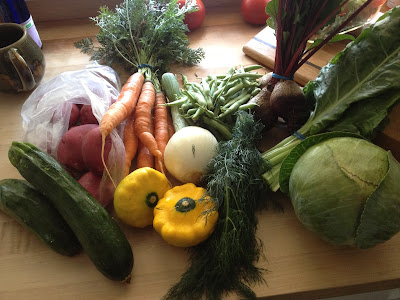
This week: sweet onion, carrots, zucchini, patty pan squash, beets, new potatoes, cabbage, dill.
I had no idea how much we would look forward to Wednesday afternoons. Our box is like opening a gift from someone who you know has your number. It’s like Christmas every week when I open the it to see what in it this time. Even though some folks are obviously weary from a long day, everyone arriving for pick-up looks happy to walk up to our front porch. I know that some weeks there may be more of one thing than we can use or put up, but there are always neighbors who welcome the extra head of lettuce or bundle of chard.

This morning when I stopped by the Farmer’s Market to get eggs from Heartbeat Farm,  (Hannah’s sister Becca and Joe’s farm. They have adjoining acres and share equipment and space.)  Joe tapped me on the shoulder and handed me this. A blushing yellow heirloom tomato as big as a bocce ball and just as heavy.
Hierloom tomato - Heartbeet Farm

Friday, July 6, 2012

My cake is slipping


Lemon Curd Layer Cake. I forgot to the fresh lemon slices on top
 Today I finished making a lemon curd layer cake. I had promised a  celebration birthday cake for Anita and Marsena, but then life got complicated and I didn’t get around to it until this week. This recipe is complicated, too. For me, anyway. But if you do it step by step the resulting cake is memorable. Four days ago I made the required six cups of lemon curd which is so good you have to hide it from yourself. Using fresh farm eggs makes the curd bright as oxeye daisies. Yesterday I made the three cake layers. Today I whipped the cream, blended in some of the curd and topped each level with curd followed by cream frosting. The final layer is covered in cream frosting, the remaining curd is spread on the top and then rest of the whipped cream is piped around the edges. So beautiful.

Maybe because it was too hot in the house, or perhaps it is just me, but the cake is sitting in the refrigerator slipping its top. Oh, and another thing, my layers came out of the oven tall and beautiful and promptly fell. It will still taste marvelous.

Beloved, my projects, my life is never quite perfect.  

I’m posting the recipe in case anyone else is in love with lemon deserts. Just know – you really need to start this a day in advance because the curd needs to cool and the frosting needs to set up for 3-4 hours. From Bon Appetite magazine…

Lemon Curd Layer Cake

LEMON CURD
2 1/3 c. sugar
2 tsp cornstarch
1 c. fresh lemon juice
4 large eggs
4 large egg yolks (save whites for cake)
¾ c. (1 ½ sticks) unsalted butter cut in pieces

FROSTING
¾ c. powdered sugar
2 c. whipping cream

CAKE
1 ½ c. cake flour
1 ½ c. sugar
2 ½ tsp baking powder
¾ tsp salt
4 large egg yolks
¼ c vegetable oil
¼ c. orange juice
1 ½ tsp grated lemon peel
8 large egg whites
¼ tsp cram of tartar

Lemon slices, halved, patted dry. ( I forgot them!)

FOR LEMON CURD: Combine 2 1/3 c. sugar and cornstarch in heavy medium pan. Gradually whisk in fresh lemon juice. Whisk in eggs and yolks; add butter. Whisk over medium heat until curd thickens and boils, abut 12 min. Pour into container or jars, cover refrigerate. Can be made 1 week ahead.

FOR FROSTING: Beat powdered sugar and 1 ¼ c. curd in large bowl just until blended. Beat cream in separate bowl until firm peaks form. Fold cream into curd mixture in 3 additions. Chill until firm, at least 4 hours.

FOR CAKE: Oven 350 degrees. Butter and flour three 9 inch cake pans. Line with parchment paper. Whisk dry ingredients – flour, sugar, salt, b. powder. Add 4 yolks, oil, orange juice, lemon peel and ¾ c. curd. (Don’t beat it quite yet because you need to use mixer to beat egg whites.) In another large bowl combine egg whites and cream of tartar. Beat whites until soft peaks form. Gradually add remaining cup of sugar, beating until stiff. Using same beaters, beat yolk mix until smooth. Fold whites into yolk mixture in three additions. Divide batter into the three pans. Bake about 25 min. or until toothpick comes out clean. Cool in pan 15 min. Turn onto racks, peel off parchment. Cool completely.

Spoon 1 c. frosting into pastry bag fitted with plain round tip. Refrigerate while you put the rest together. Place 1 layer on cake plate. Spread top with 1/3 c. curd and 1 c. frosting. Do same with the next. Top with third layer and spread remaining frosting over top and sides. Spread remaining curd on the top leaving a ¾ inch border around. Pipe little mounds of chilled bagged frosting around edge. Place lemon slices between mounds. Can be made a day ahead. 

Thursday, July 5, 2012

Birds need air conditioning too


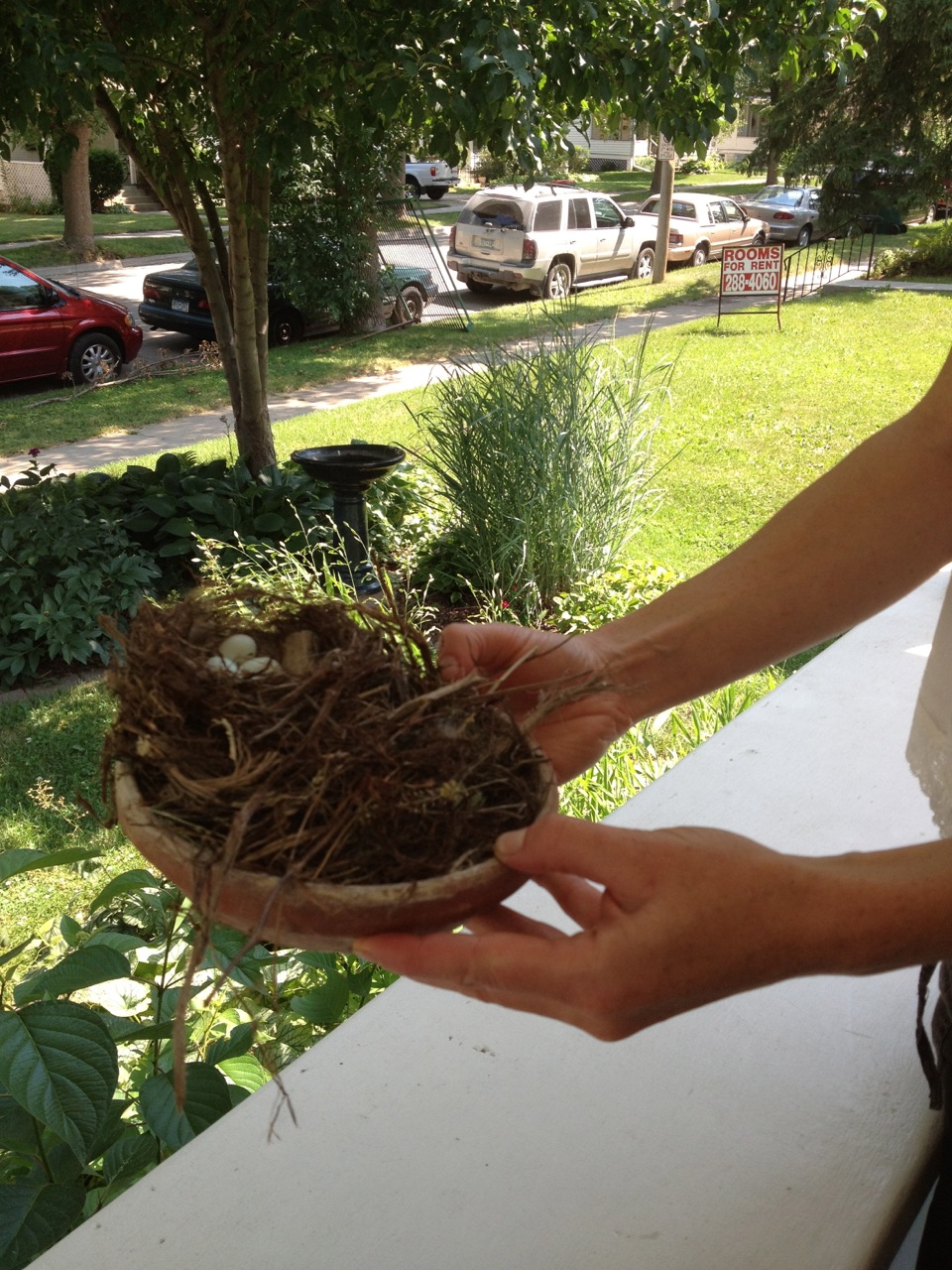
Anita reaching for the nest
A purple finch has made a nest in a clay pot liner sitting up in the corner of our front porch. She lined it with wool from the small hanging bunches on our clothes line (placed there for that purpose) and laid six tiny pastel green eggs.
Purple finch nest
It seems that in the past few days rather than incubating, she is air-conditioning them as she crouches, her beak open, her wings slightly spread, fanning them in the shimmering heat. I wonder if they will make it.
Five minty-green little eggs, each no larger than my thumbnail
 We are making it. Everyday I’m thankful for conditioned air. Last week before the oncoming spread of red heat, Denis purchased a portable unit for the main floor which is minus cooled air. It invites me downstairs as opposed to sitting under the vent in my 2nd floor office. It makes the kitchen bearable. Yesterday, I even used the oven to make Boston baked beans.