![]() |
| Squish the bean out of its membrane. |
Showing posts with label Heartbeet Farm. Show all posts
Wednesday, July 8, 2015
Fava Beans: The gift of too much work
I’ve never seen Fava Beans (or Broad Beans as they are known
in English) in our grocery stores. I’ve never known anyone to grow them. I’ve only
read about them. I think that was in Under the Tuscan Sun, but I can’t find the passage to be sure. I remember reading
about this vegetable where everyone in Tuscany or Provence eagerly awaits its early
summer harvest. Like I wait for the first real strawberries of the season or
the hope of a few morels in May. I only had the vaguest notion of what they
were like. Then a few days ago our vegetable farmer friends gave us a gift of
about a pound of fava beans. (Recipes say for a serving you should plan on a
pound of pods per person.) I think I know why they are rare in our country.
Joe and Becca sent along basic instructions. Open the pod.
Inside, find three to five large beans. Remove them. When they are all
collected, blanch them for 30 seconds in boiling water until the membrane
around each bean loosens. Quickly place them in an ice bath. Open the membrane
slightly and squish out the bean. Do this for each one. One at a time, until
you have a small bowlful. Steam them for 3 minutes until tender.
With this little batch I did the simplest thing possible to
taste them. Drizzle with olive oil and sprinkle on a little sea salt and
pepper. I now understand two things. Why Italians love them so much. And why
they are not popular here: too much work. But their buttery flavor and smooth
texture won me completely. It was worth each little step. More, please.
Saturday, July 14, 2012
Vegetables every way, every week
Community Supported Agriculture (CSA). This summer our friends, Hannah and Daniel from Easy Yoke
Farm asked if we would be their drop-off place for their CSA city members. In
exchange they offered us a free box. So every Wednesday afternoon Hannah and
baby Paul arrive with 26 boxes of just-picked vegetables.
| Stacking the boxes on our front porch. |
| Our first box of the season. |
| Hot delivery day. Hannah gives Paul a drink of cool water. |
CSA is one of the
innovative ways local and small farms have begun thriving and surviving. A
member buys in at the beginning of the season, paying all at once for what in
faith will come. Here the season runs from mid-May through early November. This
assures the customer of a weekly delivery of all the freshest vegetables and it
supports the farm with a steady, predictable income. Easy Yoke grows vegetables
only, but some farms include other things like eggs, grains, or meat. I love
that this helps small family farms survive in an agricultural climate that is
now geared mainly for mega-industry.
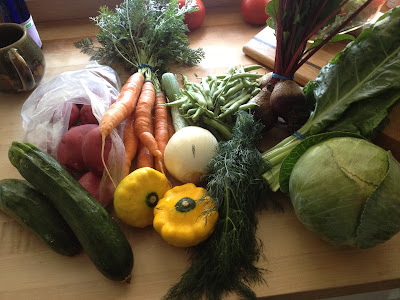
| This week: sweet onion, carrots, zucchini, patty pan squash, beets, new potatoes, cabbage, dill. |
I had no idea how much we would look forward to Wednesday
afternoons. Our box is like opening a gift from someone who you know has your
number. It’s like Christmas every week when I open the it to see what in it this
time. Even though some folks are obviously weary from a long day, everyone
arriving for pick-up looks happy to walk up to our front porch. I know that
some weeks there may be more of one thing than we can use or put up, but there
are always neighbors who welcome the extra head of lettuce or bundle of chard.
This morning when I stopped by the Farmer’s Market to get eggs
from Heartbeat Farm, (Hannah’s sister Becca
and Joe’s farm. They have adjoining acres and share equipment and space.) Joe tapped me on the shoulder and handed me
this. A blushing yellow heirloom tomato as big as a bocce ball and just as
heavy.
| Hierloom tomato - Heartbeet Farm |
Labels:
Easy Yoke Farm,
Heartbeet Farm,
Toad Hall,
Toad Hall kitchen,
Work
Saturday, May 19, 2012
If rabbits ran your farm
![]() |
| Becca of Heartbeet Farm brings the tractor in from the field. |
![]() |
| Greenhouse shared by Heartbeet and Easy Yoke Farm. |
Last night we saw a local showing of Greenhorns – a documentary about young farmers around the country
who are trying in unusual places and ways to bring nutritious, pesticide-free
food to the table and earn a living at the same time. I’d recommend viewing it.
These young people are energetic, innovative, educated and very thoughtful
about what they’re trying to do. (Is that a little excessive, Margie?) They are building greenhouses on empty lots
in the middle of urban mission districts, reclaiming broken farms, and setting
up small shops to sell true artisan foods in the midst of cities. They face
enormous financial hurdles, relentless labor, and discouraging government policies.
We admire them because we’ve witnessed how they love what they do and we’ve
eaten their crops as fast as we could shove shitake mushrooms and potatoes into
our mouths.
![]() |
| This was a full-grown rosebush complete with yellow roses sitting on top of the stand |
![]() |
| Eaten down to nubbins. |
![]() |
| She looks slightly evil as she ignores the radish tops. |
While we were busy watching the film and listening to the
discussion that followed, Honeysuckle was busy at home. We had a small rosebush
sitting on a stand on the porch. She decided to harvest it before we could
transplant it. We never imagined she’d pull it down and eat the whole thing,
thorns, yellow blossoms and canes right down to nubbins. On a tiny scale this
is proof of what animals can do to your investments if you allow them to run
the business. Turn your back for a second, leave the gate unlatched... just another hazard to factor in if you farm animals.
Labels:
Farming,
Heartbeet Farm,
Honeysuckle,
mushrooms,
Organic vegetables,
Toad Hall
Wednesday, February 22, 2012
Corn for our seeds
In today’s Common Prayer – February 22 – we read this prayer:
“Lord God, extend our faith so that even when we fail to see the fruit of our planted seeds, we may have the assurance that every inch of soil overturned will lead to a harvest some day.”
Last summer our organic farmer friends gave Anita bag of seed corn that was a year old. Joe and Becca said plant however much you want, we can’t risk low germination from old sweet corn seeds. They also generously gave her space for six 100 foot rows. It has always been her dream to grow enough sweet corn for eating delicious golden kernels all winter. The thing is, you might have a good harvest off the ten to twelve corn plants you put in your small urban garden, but that’s still only three ears per corn plant? Three dozen ears altogether? Unless you have room for a lot, it’s a waste of time and space. So the possibilities of corn through the roof had her hungry-eyed.
This is what happened. We had so much corn we could have begun a factory farm of feeder hogs. We raved over the sweet, tender ears, we ate them like chainsaws – sawdust flying, protective goggles over our eyes.
It had reproduced itself five hundred fold with wild energy. We ended up freezing 46 quarts and giving away at least 20 dozen ears. For the first harvest we picked three or four wheel barrels full and pushed it up to the yard where we set up a little canning factory. Anita picked, Denis shucked, I cut the kernels off the cob, and together we heated it to boiling point on a camping stove and then put it all in zip lock bags. Tato, the dog ate cobs as he could and all the leftover greens and cobs were dumped over the fence to the chickens and pigs. And that was just the first picking. It’s almost March and we still have plenty of corn to eat.
thought a lot about that harvest and everything that had to coalesce under sunny days and warm nights to make it so darn good. This rarely happens in life. Sometimes. But rarely. You invest and invest and once in a blue moon you get to see where that seed went and what it did. The prayer above is mostly how it is. Maybe years later you get a facebook message thanking you for all the pizza you served the youth group and how they’ll never forget listening to Purple Rain and thinking about Ferris Buellers Day Off in your living room. We need to keep stumbling down the row year after year because you never know when the corn will come home. But even if it doesn’t, we are assured by God that he grows a great harvest that will overflow all our wheel barrels and burst our freezers.
Anita and I picked the first load.
Denis did the shucking while I began cutting it off the cobs.
Anita took a turn with the knife while I began blanching the corn.
The Chickens feasted on all the leftovers.
We made a huge pot of corn chowder on the camp stove in the yard and ate it with Joe & Becca and all the interns. All fresh - even the milk came out of the Jersey cow that morning.
Labels:
Common Prayer,
Faithfulness,
Farming,
food,
Heartbeet Farm,
Joe and Becca's Farm,
prayer
Saturday, July 30, 2011
Take this tomato and eat it
Today Denis and I made our usual Saturday morning trip to Farmer’s Market. It never gets old – the anticipation, the festive atmosphere, this season of knowing that for the rest of the week I’ll have a fresh supply of choice vegetables and herbs for our meals. Winter will be here soon enough when there’ll be no such thing as a fresh golden tomato. Or the blinding heat of the sun bouncing off the tops of awnings. Baskets, shelves, buckets groaning with mounds of vegetables, herbs, flowers. Vendors selling chicken, pork, beef, elk, buffalo most of it happy-meat. Hidden Stream Farm. Hillside Farm. Veerman’s Ranch. Many Hands Garden. Friendly Acres. The earthy, basil-ly scent in the air is killing, making me decide pesto pasta and fresh tomatoes will be on our menu this week. We pass a stand where they are grilling steak from grass-fed beef and handing out free samples. People of all ages and colors push past arms loaded with produce and bouquets of zinnias.
Denis and I head straight for Heartbeet Farm and Easy Yoke Farm stands. The owners are friends - two young couples – their land and lives connected by the same calling in life – to grow vegetables that are chemical-free and incomparable to anything I could buy at Hyvee. Recently we brought an evening meal out to the farm, and as the sun went down, sending dappled shadows across the yard, - those soft and tender rays that cool the last of the day - Daniel wanted to take us through the lanes to look at the fields and the land where he and Hannah hope to build their home. (Joe and Becca have been at it a little longer and are more established.) Over near that big tree in the pic below.
He showed us the onion field – 10,000 plants. Today I bought three.
I felt rich, rich as I unloaded all the vegetables to my kitchen counter. The tomatoes – purple heirlooms that Joe says have a slightly smoky flavor, and he’s right! The cherry golds so sweet it’d be easy to think of them as desert. We had eggs, scallions, Hungarian peppers, red pepper, green bell pepper, summer spinach (a broader leaf, tender and mild), celery (intense flavor), a bouquet of basil, two kinds of cucumber – small pickling cucumbers good for slicing with onion vinegar and oil in a simple salad and the long English cucumber for spear eating – and potatoes. Daniel was inspired to plant a few in the forest near the river bottom in the rich sandy soil, so of course: Forest Potatoes and he insists I tell the story of them. They taste real, honest, crisp. Quite amazing.
For lunch we ate a piece of wheat bread layered with Boursin cheese, thick-sliced tomato and basil leaves. I’m thinking of the same thing for supper.
Subscribe to:
Posts (Atom)