Friday, December 27, 2013

Waiting out the night

I've been a long time away from my blog and other forms of social media. There are reasons. Some because of busyness and good things that kept me occupied. Others, well, others because maybe priorities don't include posting pics of our fabulous Christmas dinner, or the beautiful four hour blizzard on Christmas eve after lessons and carols that made you glad you weren't slouching to Bethlehem on a donkey, or I might be discouraged, (depressed?). For days (until two days ago) I hadn't even written in my journal.

But I'm here today dipping a toe back in the icy water.

I've always loved the writing of John McPhee. He writes about the oddest things and then makes you wonder how you could justify never having thought about the shad. He wrote an entire book about them. Last year Anita gave me a copy of The Founding Fish. EVERYthing you'd ever want to know about shad. 

The following quote may energize me enough to get started writing again myself.

   They (shad) move upstream at first light - an optimal time, when muscles are rested. And resolutely they move in the afternoon, Kynard guesses that the falling light reminds them that another day is ending and they've got to get on with their mission. "That drive to get upstream is strong. It must be particularly forceful when they sense that they are losing light." 

 This reminds me of what I do all day (nothing). I sharpen imaginary pencils and look out real windows. The light of a computer screen seems far too bright to me. I kill hours, hoping for distraction, and complain bitterly when distraction occurs. Three, four, five P.M. Nothing whatever accomplished. The day coiling like a spring. Nothing is worse than a lost day. Panic rises, takes over, and I write until I go home at seven, thinking like a shad.

   When daylight drops in the evening, the fish turn and retreat from rapids, because they can't maintain orientation. "They go backdown, but not far. They find the very first deep slow-water area. That's where they stay. They just kind of settle down to the bottom. Get down to a lower velocity. Get in the current, where they can just maintain position. Let the lateral line take care of keeping them up, and not moving downstream." As if they were treading water, they wait out the night. (p. 32)

Tuesday, November 19, 2013

Stacked Enchiladas for a cold day

Stacked Enchiladas
Stacked Enchiladas ready for the oven

I have a friend who will soon deliver a new baby - her second child. Liz is also a lively writer and a great cook. She has combined these two skills to make one of the few blogs I regularly read - Carpe Season - "Living seasonally in an under seasoned world." Right now she is trying to prepare her family for an event she knows will change their lives in ways she, well, it is hard to accurately predict what life is going to look like on the other side of second baby, isn't it? I remember someone telling me it's the third one that either makes or breaks you - after that it doesn't matter. She had seven children. I didn't know whether to be relieved or frightened. Even now with adult children I can't say whether that is true or not.
Liz came up with an idea to help her family eat well even as they transit from three to four. She called on some of her friends to send their favorite make-ahead and freeze main dish meals. She plans to make one now and freeze one for later.
I was inspired to send her a family favorite that dates back to our New Mexico days when we lived next door to a Hispanic family. Their Nana made the world's best flour tortillas. Fresh every day. Like it was nothing. Like me toasting a piece of bread. I wish she was still my neighbor. It surprised me that they often made the following dish that was considered lazy, fast, and unauthentic Mexican food. I RARELY, rarely use Campbells cream of anything soup, but for this - I break my rule, unless I have some good leftover chicken broth. This delicious dish can easily be made gluten-free, especially if you make your own cream soup.
This is not difficult to whip up and the ingredients are easily kept on hand for a cold fall day. When served with a side of refried beans, fresh salsa and a simple fruit salad - this is comfort food. Around here, anyway.

Stacked Enchiladas
1 pound ground beef, browned and seasoned with garlic, salt and pepper
10-12 corn tortillas
12 oz grated mild cheddar cheese
1 can green chiles (optional to use more)
1 small onion diced
2 cans cream of chicken soup
1 can milk
Butter two small casserole dishes to make two main dishes that will make three servings each. One to eat now. One to freeze. Or use a larger baking dish to make a main dish that serves approximately five and eat it all at once. Number of servings vary according to appetites. (A cast iron skillet also works well for this recipe.)
Brown the ground beef, set aside. Mix soup and milk in a largish shallow bowl. Grate cheese, set aside. Chop onion, set aside.
To assemble casserole: dip a tortilla in the soup mix so each side is drenched. Place in bottom of dish. Sprinkle a bit of ground beef, 1 T raw onion, 1 T green chile, a little sprinkling of cheese. Repeat layers until the tortillas are used. (In a large casserole dish use 1 1/2 or 2 tortillas. Tear them to fit the shape of bottom.) Pour any remaining soup and a generous amount of cheese over the top. Bake at 350 degrees for 30 minutes or until it bubbles.

Wednesday, November 6, 2013

There are Chickadees


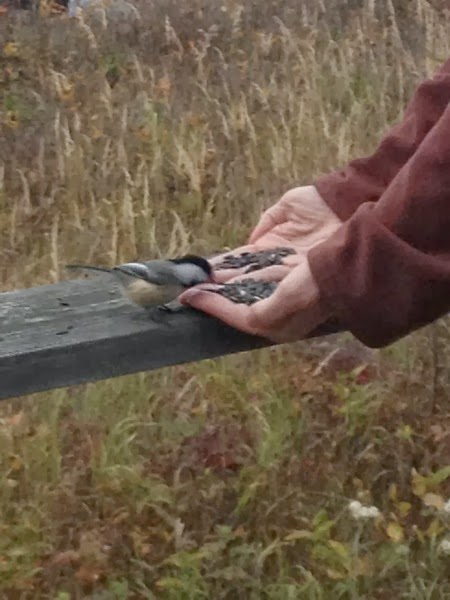
One thing I've always wished I could experience is to have a wild bird eat from my hand. I've always loved chickadees - they are so small and cheerful. I've heard they aren't too difficult to entice, just stand outside until your hands and feet are frozen stiff and hypothermia followed by rigor mortis sets in.
Last week I did it. I stood on the deck of the cabin. Waiting, waiting. Waiting for them to overcome their fear of me. There was a flock of them flitting about because they'd already been careening in and snatching from little piles of black sunflower seeds I'd scattered on the railing. When they were nearly gone, I posted with my hands cupped, those seeds a little siren song seducing them.
I was about to give up when, to my surprise, the nuthatches came! Hopping along the rail, making little chirrups, clutching my fingers with their tiny feet, sorting the seeds,with their needle-nosed beaks, tossing away several before finding the exactly right one. I was enthralled. Finally, a brave chickadee skidded to a stop about six inches away. She arched her head, eye-balled a seed, hopped on my thumb, grabbed it and arced away. I could feel the tiny draft of her wings as she pulled up. They kept coming. I tried not to laugh for the joy of them.
I just heard about a woman with four young children who has Stage IV breast cancer. As we know, "there is no Stage V." Her heart bursts and breaks with love and longing for her children and her spouse. She strives to remain in Christ during her long sleepless nights.
So, I wonder. Why am I blessed with chickadees and nuthatches? There is no short answer to this. It seems that as long as I live I will need to review questions about suffering and persevering. I read C.S. Lewis. Edith Schaeffer. J.I. Packer. Others. And am temporarily satisfied, but is it my memory that has so many holes in it that I must return again and again to be reminded? I think so. And, I also turn Scriptures that assure me that God "prepares a table before me in the presence of my enemies." (Ps. 23) And further, "goodness and mercy will follow me all the days of my life." So, God, please bring comfort to that young woman. Prepare a table for her that sustains her through the valley of death. And thanks for the birds you brought to my hands - they were goodness, a kind of evidence that you have not abandoned us or your creation.
Chickadee
Handfuls of goodness

Friday, October 25, 2013

Fleas!

Here's a new reason for "cooking the books."  I just pulled the last load of books out of the oven after an hour at 185 degrees. Before that it held a canvas book bag, my computer cover, Denis' wool stocking cap and a Bible.
We just returned from vacationing at a very quiet, sweet spot. It was a much needed time away for rest and refreshment. It was almost perfect. Except that on our first evening, I noticed something very tiny moving on my knee, which I pulled as close to my nose as joints allowed for inspection. It looked like a little piece of dirt on my blue jeans except that it moved, like when static electricity causes a small seed to jump. It was a flea. I stood up to look at the wrap I was sitting on. It had more jumping seeds. I yanked it off the chair, screamed in a quiet fashion so as to alert my husband that something was wrong, who merely said, do you want to go home? No. Not really. So for a week, we simply tried to ignore … no, that isn't quite right. I kept catching them on the bathroom floor with dampened toilet paper where they easily showed up on the white tile (as if flushing one or two every three hours would make a difference in their population). Denis dealt with them by refusing to discuss or acknowledge them, choosing denial as a means of coping. I admire him.
The day before we left, I posted our status on FaceBook. Fleas. Help! What should we do? The response was fairly large and adamant. I shouldn't mess around. I even got a phone call from a friend in Missouri who had immediately spoken with another friend who is an "Exterminator."  I was to seal everything in black plastic bags. Don't even think about bringing it in the house. The expert and others said go to a laundromat and wash and then dry everything on high heat. Sigh.  Or… do what I did and what a few others recommended. Dump everything on the lawn. Take it in a load at a time. Launder and dry it. Bake your books and anything else you can't put through a dryer. I've done all that.
The last load to go in late this morning was the big white cotton blanket (we needed to bring our own linens) you see in the middle of the photo. A few minutes ago I pulled it out of the dryer and out of curiosity, I was examining whatever little black flecks of dirt and lint clung to it. Perhaps I shouldn't have done that. One of the specks sprang away. It did it again. I bent close. A live flea. It's back in the dryer on the highest heat the dryer can manage. I may run it for 36 hours.
I know you don't feel too sorry for me. After all, we haven't needed to bomb the entire house, or move out like some of you have. We don't even have noticeable bites. And I've just finished reading Unbroken by Laura Hillenbrand about a Japanese WWII POW. The vermin they had to live with for months, even years at a time! Whatever can I be complaining about?
Perhaps just a couple survivors will not make any difference to us? Perhaps they won't find each other and breed like flies. Perhaps they specialize in biting dogs only. Or cats. Maybe they are just harmless little fleas who eat grass. Perhaps this will discourage visitors from coming to Toad Hall. And now I will be able to do everything I've put off for years. Except that pausing to scratch my waist every ten seconds may cripple my progress. Am I obsessed? Probably.
Fleas

Tuesday, October 22, 2013

Giant Puff Ball

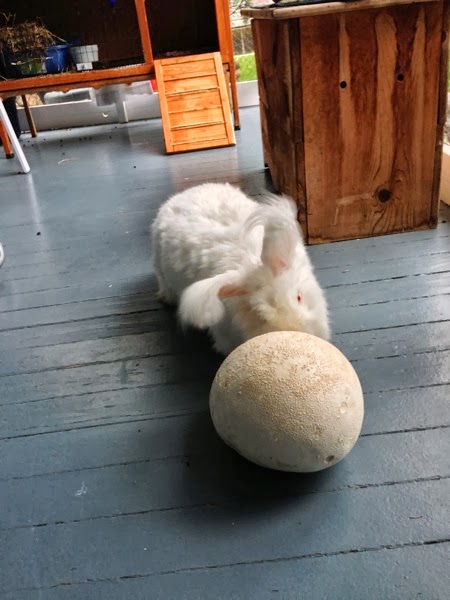
I know, after being gone from here for so long, you'd think I'd come back with something really profound. But when I think of it, what is not profound about this very strange and rather rare mushroom? If you are on a hike in the woods and happen to glance off into the undergrowth and notice a large round white object it is probably a Giant White Puffball. It is so startling, you can't help but think that some kid lost a soccer ball. If you can find it early on, when it is still young and dense, they are delicious. Along with morel mushrooms, there is no mistaking them for anything else. Seriously. You would be safe eating them. Their pure white flesh tastes a little like mild cheese. 

Anita found this one and brought it home. When I first saw the photo, I thought you could easily mistake Honeysuckle for a miniature bunny who was examining a button mushroom. (Denis and I are not home right now - having taken some vacation time to be on the North Shore - our favorite spot for decompressing in this starkly beautiful place.) She reports that last night she made a brown rice risotto with kale and mushroom and it was delicious.

Mushroom

North Shore


Friday, September 20, 2013

God Answers Denis' Prayers about Wild Mushrooms

Mushrooms Boletes
Ceps?

So, last week among the mushrooms springing up beneath the thickets on this lonely point where we were staying, I found what looked like the Cep, also known as the King Bolete. These large, brown mushrooms are found and eaten everywhere in Europe. As an American I've felt lame and ignorant when it comes to harvesting and eating what is so OB-vious to other people everywhere. And FREE! There are some species I know beyond any shadow of doubt. Like Morels which, if you know me you are sick of hearing about. The Common Puffball is pretty safe as long as you don't confuse it with a very young mushroom of another sort in its early stages. Once, I even found the Giant Puffball. They are so enormous,I swear when I saw it in the woods from a distance, I wondered who on earth kicked a soccer ball to here!? It deteriorated before I could eat it all.
Anyway, I was relying on some of my guides to help me figure out what is edible and what is not. Two of my favorite guides:
Edible Mushrooms by Clyde M. Christensen  He is a no nonsense kind of guy who believes the best way to harvest edibles is not by knowing all the poisonous ones - there are too many - but to know the edible ones so well you will never make a mistake.
Mushrooming Without Fear: The Beginner's Guide to Collecting Safe and Delicious Mushrooms by Alexander Schwab is a fantastic guide. He show-cased some of the most common edible mushrooms and each species had many photos and characteristics to look for so you would never, ever mistake them for anything deadly. I trusted him. Even when I read:  "the white network on the stem of the King is very clear and makes identification almost foolproof." It is that "almost" that is a little unnerving.
After fingering each page of his book, I couldn't stop myself gathering a whole lot of the best examples, Ceps, Birch bolete, Larch Boletus, Puffballs. Then, I brought them inside and prepared them for supper.
Many mushrooms
Ready to clean

Mushroom Mix
Mmmmm!

I peeled the caps - they all had a membrane that was easy to pull off - cleaned them, dried and sliced them. Sautéed them in a little butter, added chopped garlic, chicken broth and white wine and commenced reducing the liquid. The aroma filled the cabin and I couldn't wait.  As they simmered away, I thought, "I'll just take my iPhone and google poisonous boletus because, just in case. As you probably know, anyone who is a situational hypochondriac should stay away from Google. So I found a ton of sites that mentioned that some Boletus are difficult to identify and some species might make you sick especially if you are elderly or a little unhealthy or just don't care to risk 48 hours of your life blowing out your intestines.
Denis was reading on the porch when I rose from my chair and confessed that after a little more research I didn't think I should take the chance. His relief shocked me. I hardly believed him when he said he had been praying I WOULD NOT even taste them. He insisted he was sincere. If he had tried to stop me, I suppose I would, of course, have eaten the whole mess. This is not a virtue.
I stepped into the bathroom for a minute and when I came out the pan was empty. Anita had already dumped them in the trash.
I need a living mentor. Where is she?!

Thursday, September 19, 2013

Stink Horns and Fly Agaric Mushrooms

On this small point of Wisconsin land that gently bulges into Pike Lake there must be several dozen species of trees from larch to maples. Last week something in nature aligned with trees, weather and decaying earth because the ground gloriously released hundreds of mushrooms. Everywhere. Some as big as dinner plates and as soft as Nerf balls, others so tiny and camouflaged you would never spy them unless you stared at your feet for a hundred years.
WI Cabin
Pike Lake Cabin

Boletes
Boletes Not sure what kind. Perhaps "Red Cracked"
I saw lots of boletes - distinguished by a hundreds of tubes on the underside giving them a sponge-y feel and appearance. Dozens popped in the grass just outside the cabin door - golden nuggets blending with the yellow leaves that are beginning to fall from the maples. I was sure they were  larch boletes and I collected them, determined to eat them later. We found several fairy rings - mushrooms that are supposed to be delectable, but we decided we needed more information on them.
Fairy ring mushrooms
A Fairy Ring

Fly Agaric 1
Immature Fly Agaric (Aminta muscaria)

Fly Agaric 2
Huge!!

Two of the most fascinating species (I can't identify that many) were unmistakable. Aminita Muscaria - the beautiful poisonous Fly agaric. I love finding this legendary mushroom of fairy tales and wood elves. When young its round cap varies in shade from orangey-red to straw yellow and sits perfectly round on a white stem. The cap is covered with white or pale yellow warts. As it matures it flattens and broadens into a plate that can range from three to ten inches across. It attracts flies who lap up the sticky surface with their little tongues, go into a dizzy dive and fall dead. Apparently there are folks in Siberia (and who knows where else) who risk enjoying the hallucinogenic properties and live to tell. But I guess its a gamble, not everyone survives. So how good could the trip be? Or how bad your life? (I never fail to exclaim.)
Stinkhorn
Stinkhorn Mushroom

Denis alerted us to a stinkhorn mushroom. Yes, it stinks and yes, it's shape is disgustingly hornish. He had wandered over to a bench near the water and got a whiff of something so revolting he looked around thinking he had stepped on a rotting carcass. As he peered into the grass he noticed an odd-looking mushroom. It was about six inches long and the cap was covered in an olive-green evil-smelling slime. As Denis wafted the air my direction I took an involuntary step back. By the end of the day it was covered with flies and black beetles fighting for a place at this slimy table.
I never fail to wonder at the strangeness of mushrooms. At their mycelium which lurk unseen in rotting wood, garden soil, even in the foundations of our homes, at their fruiting bodies suddenly appearing out of nowhere in mind-numbing varieties. That they can be literally drop-dead gorgeous and kill you in a single bite or be so delectable you crave them like crack cocaine. All these things are why I am bewitched by them and that God should make so many! As many as the stars, perhaps.